On October 23, the opening ceremony of the 2026 Global Governance Forum (Xiong’an) was held in the Xiong’an New Area, Hebei Province. WANG Yi, member of the Political Bureau of the CPC Central Committee and minister of Foreign Affairs, attended the ceremony, read out President XI Jinping’s message and delivered a keynote address. He announced eight practical actions to be taken by China to further implement the Global Governance Initiative, including the release of the Progress Report on the AI Capacity-Building Action Plan for Good and for All.
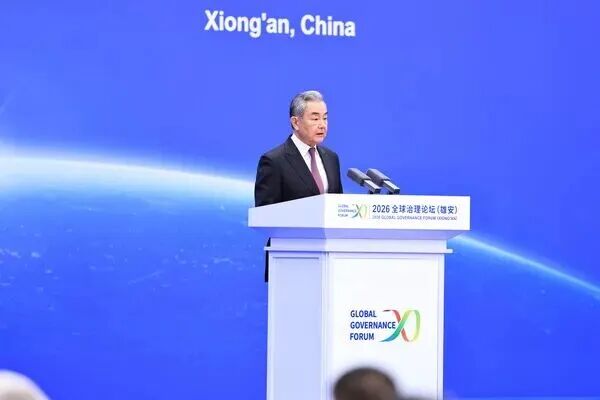
WANG Yi delivering a keynote address at the opening ceremony of the 2026 Global Governance Forum (Xiong’an)
Photo: Ministry of Foreign Affairs of China
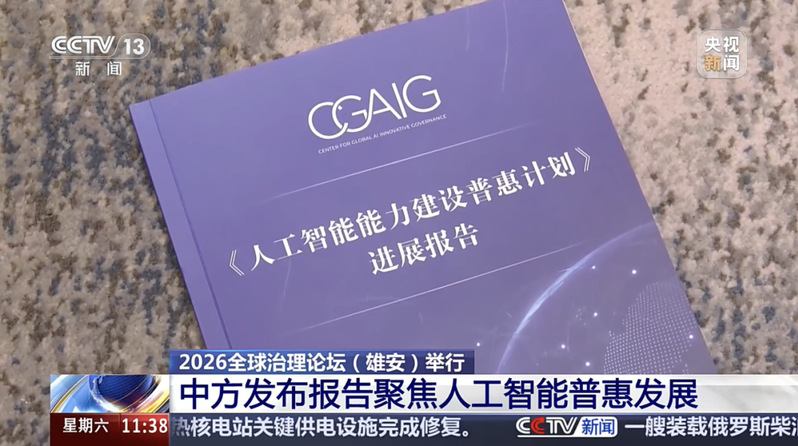
The Progress Report on the AI Capacity-Building Action Plan for Good and for All (hereinafter “the Report”) was prepared by the team of the Center for Global AI Innovative Governance (CGAIG). Professor CHEN Zhimin, vice president of Fudan University and executive director of CGAIG, was interviewed by China Media Group (CMG) and elaborated on the key findings of the Report at the sub-forum on “Promoting Inclusive and Equitable Development of AI”, hosted by the Chinese People’s Institute of Foreign Affairs and co-organized by the China Institute of International Studies.
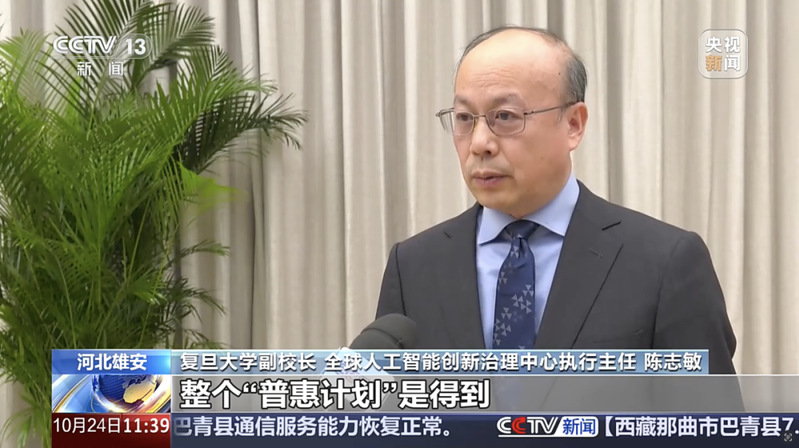
CHEN Zhimin being interviewed by China Central Television
Photo: CCTV News
The Report notes that, amid the accelerating evolution of the AI divide, the need for strengthening AI capacity building has become increasingly urgent across the international community. The focus of Global South countries has broadened from direct access to technology to addressing gaps in industrial capacity, talent reserves, data resources, language corpora, and safety governance, reflecting the Global South’s call for equal participation, greater autonomy in their development and greater representation in rulemaking.
Two years ago, China proposed the AI Capacity-Building Action Plan for Good and for All (hereinafter “the Action Plan”), which responded to the real needs of Global South countries and has since been translated into cooperation mechanisms and concrete projects. Under the UN multilateral framework, the parties concerned have built channels for cooperation through the Group of Friends for International Cooperation on AI Capacity-Building. Cooperation has expanded from isolated forms of technical assistance to integrated capacity building spanning data, models, talent, sectoral applications and safety governance, with the range of participants continuing to expand and diversify.

The Progress Report on the AI Capacity-Building Action Plan for Good and for All
Photo: CCTV News
The Report selects a number of representative cases from the implementation of the Action Plan’s ten actions. For example, FlagOS, an open-source AI computing infrastructure, has significantly lowered barriers to AI development and application in developing countries; the MAZU disaster early-warning system uses AI to support the implementation of the Sustainable Development Goals; and the World Artificial Intelligence Cooperation Organization (WAICO) provides a platform for international cooperation. The implementation of the ten actions also covers large AI models for basic scientific research and the development of multilingual large AI models, education and training for capacity building, data governance and cross-border safety governance, establishing a comprehensive pathway from access to technology to the capacity for independent development.
Based on a systematic review of two years of practice, the Report distills four key lessons: first, access to technology is the starting point; independent development is the goal; second, demand-driven approaches, extensive consultation and joint contribution determine whether projects can be delivered; third, data, models, talent and governance must be advanced in a coordinated manner; and fourth, openness and open source are the prerequisites for inclusive development.
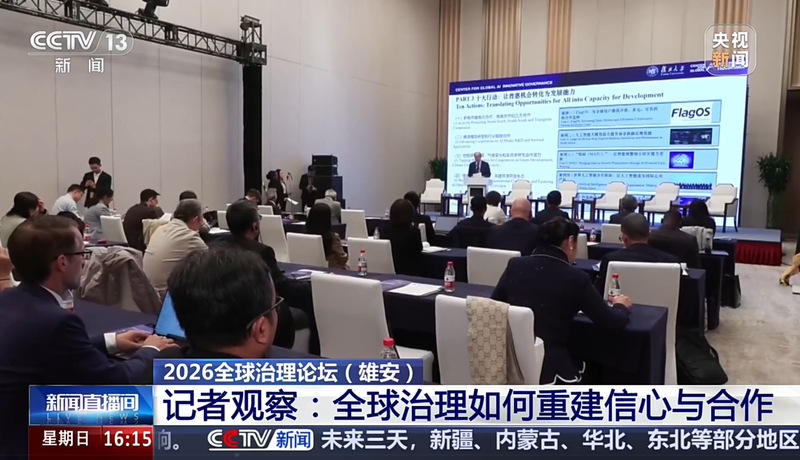
Chen Zhimin elaborating on the key findings of the Report at the sub-forum
Photo: CCTV News
Over the past two years, the Action Plan has moved from a statement of principles toward practical action for the benefit of all. Bridging the AI divide cannot be achieved through one training course or one project; it requires sustained effort over the long term. Looking ahead, as the Action Plan advances into its next phase, stakeholders at home and abroad should contribute further to building a broadly agreed global governance framework, standards and norms, and action guidelines, continue to strengthen capacity-building support, work together with all parties to advance development through cooperation, and translate more research results into affordable, sustainable and replicable international public goods, so that AI can truly become a mighty force that increases the well-being of humanity and advances human civilization.
The preparation of the Report and the presentation of its findings represent the latest results of CGAIG’s ongoing monitoring of and active engagement in the global AI governance process. Leveraging Fudan University’s strengths in global AI governance, interdisciplinary research and international cooperation networks, the Center has taken an active and sustained part in building global AI governance mechanisms under the United Nations framework, promoted the establishment of the UN-supported Global Network of Centers for Exchange and Cooperation on AI Capacity Building (AICDN), actively advanced the mobilization of capacity-building resources and the implementation of related initiatives, and continued its research on global AI governance, particularly on capacity building for the Global South.
Download the Report (Chinese version):
https://www.fmprc.gov.cn/wjbzhd/202610/P020261023815175879929.pdf
Download the Report (English version):
https://www.mfa.gov.cn/eng/wjbzhd/202610/P020261023824736524490.pdf
Website of CGAIG: https://cgaig.fudan.edu.cn
(END)
Source: Center for Global AI Innovative Governance
Editor: WANG Mengqi